
Chartreuse is more than green and yellow. The current range runs to some ten bottles, from the 69 per cent Élixir Végétal to the V.E.P. that ages for years longer. Beyond that lies more than a century of historic bottles from Fourvoirie, Tarragona, Marseille and Voiron, and a series of limited editions that collectors chase the world over. This page lays it all out: what is on sale today, what once existed, how to date an old bottle and what it fetches at auction.
The current range
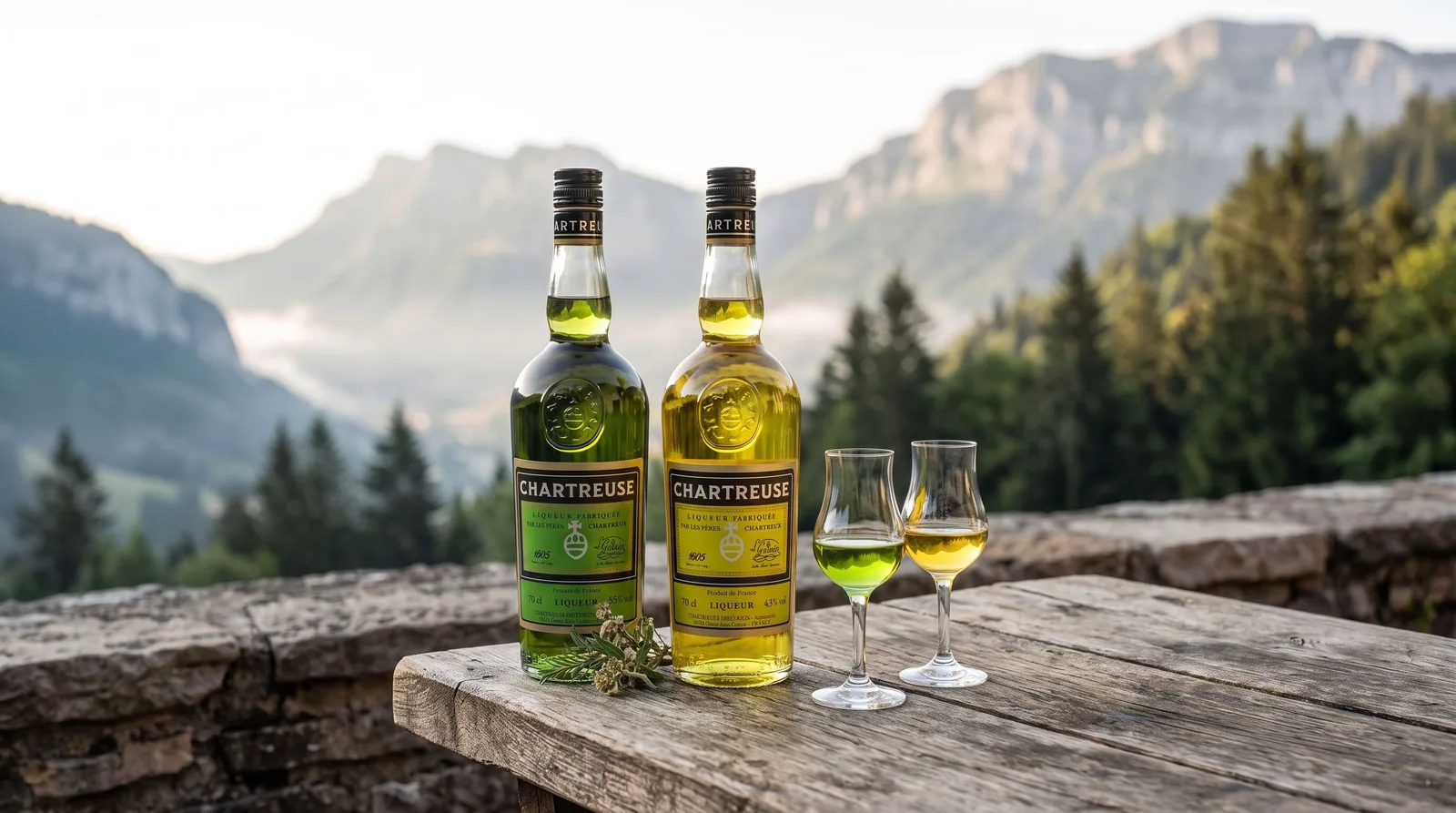
Chartreuse divides its liqueurs into three groups: the traditional liqueurs, the cuvées spéciales and the cuvées d'exception. The génépi stands apart. The figures below come from the product pages of chartreuse.fr, consulted in November 2026. The year for the génépi comes from the brand's history page; Wikipedia places its start only in the 2000s.
| Name | ABV | Sizes | Since | Characteristic |
|---|---|---|---|---|
| Chartreuse Verte | 55 % | 3, 20, 35, 70 and 300 cl | 1840 | 130 plants, naturally green; bottle with bulbous neck and embossed seal of the order |
| Chartreuse Jaune | 43 % | 3, 20, 35, 70 and 300 cl | 1840 | softer and sweeter; intense yellow from plant macerations |
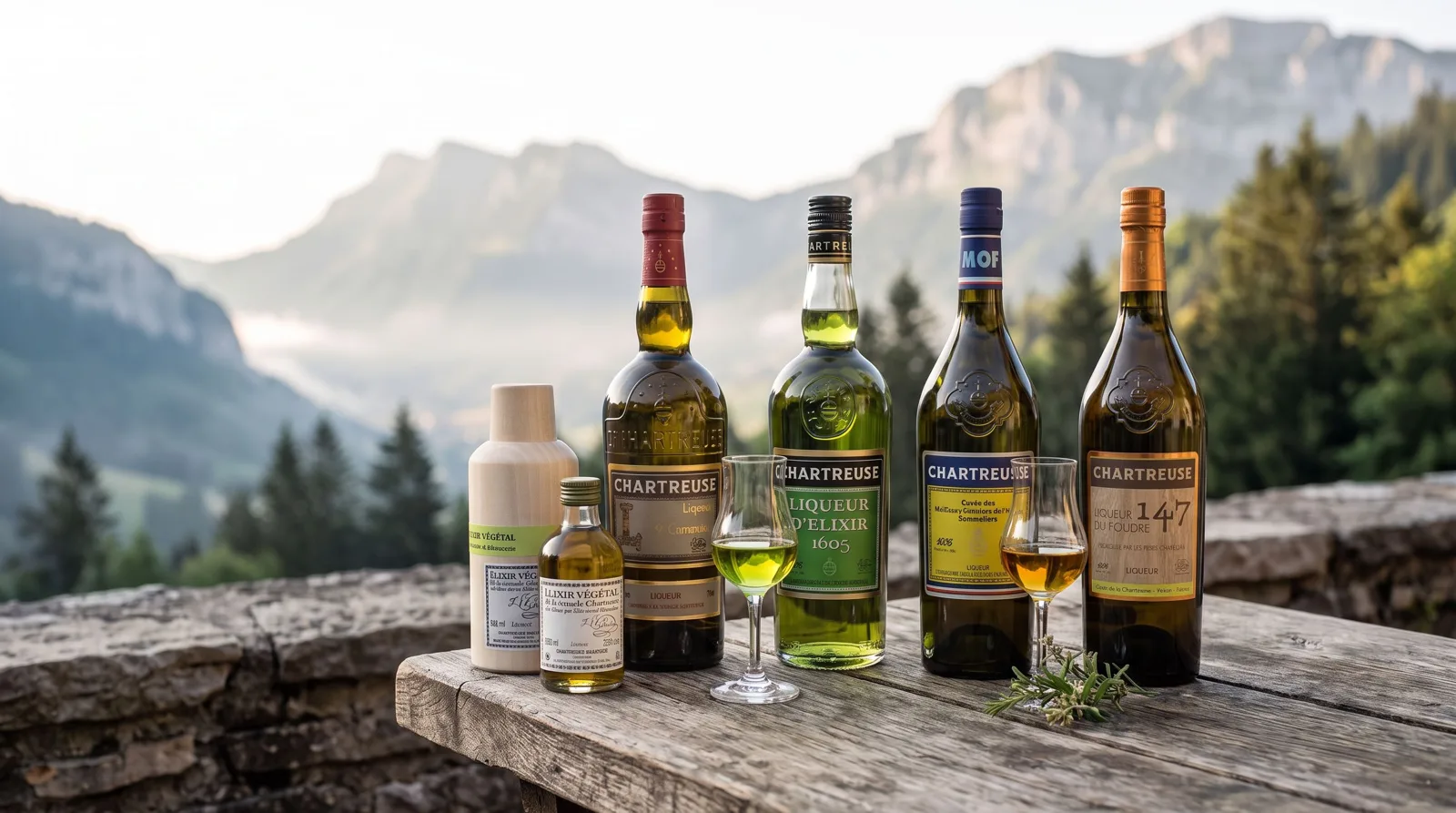
| Élixir Végétal | 69 % | 10 cl flask in wooden case | 1764 | by the teaspoon, on sugar or in a grog; the case protects it from light |
| Liqueur du 9e Centenaire | 47 % | 3, 70 and 300 cl | 1984 | 900 years of the Carthusian order; smoked glass, cork, numbered back label |
| Liqueur d'Élixir 1605 | 56 % | 3, 70 and 300 cl | 2005 | 400 years of the d'Estrées manuscript; smoked glass, dark green label |
| Cuvée des MOF Sommeliers | 45 % | 3, 70 and 300 cl | 2008 | fresher, livelier Jaune; yellow label with blue-white-red border |
| Liqueur du Foudre 147 | 49 % | 70 cl | 2019 | extra ageing in foudre 147 in Voiron; wooden label; only at the Voiron shop |
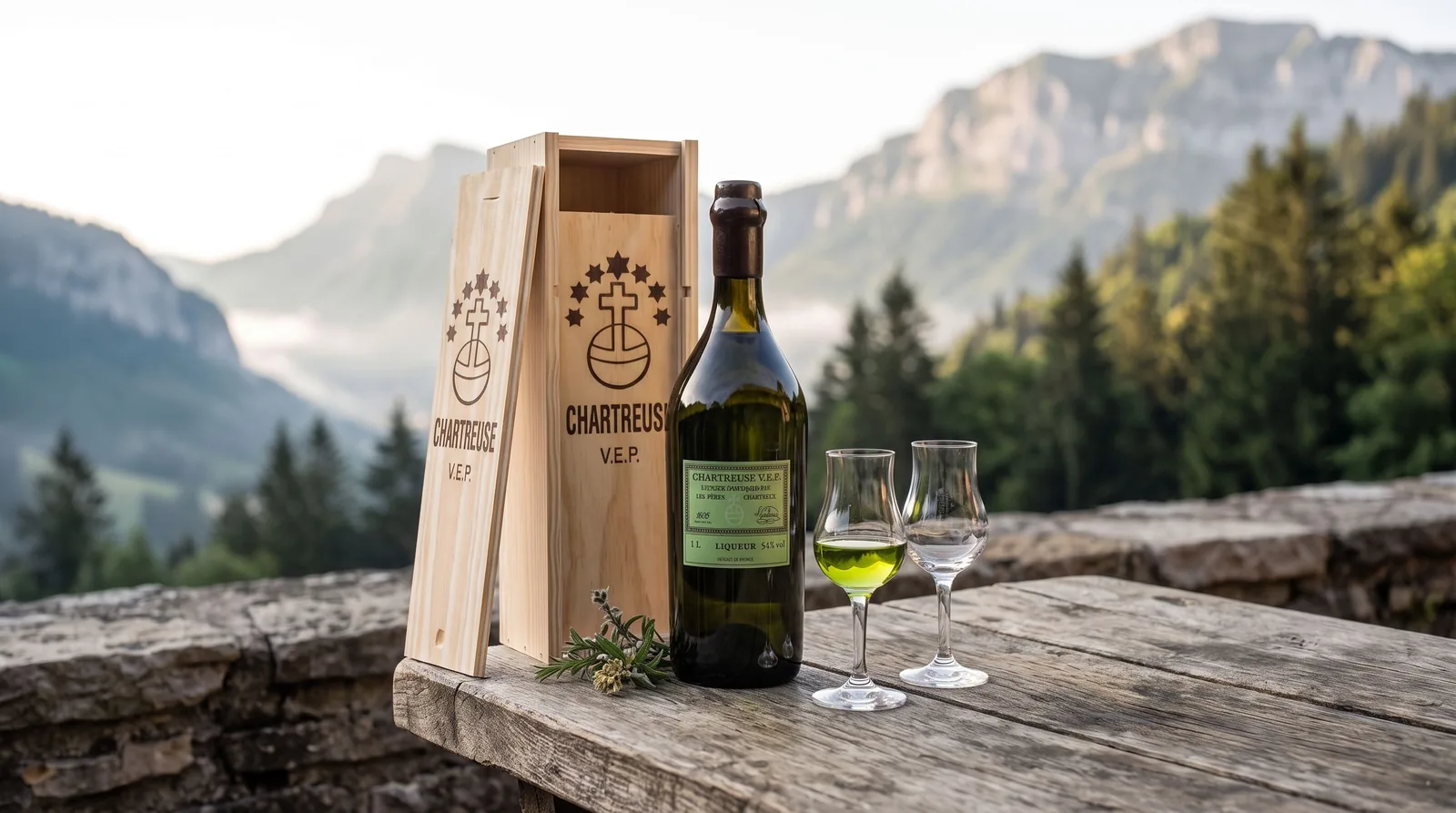
| V.E.P. Verte | 54 % | 100 cl | 1963 | many years in demi-muids; numbered, wax seal, wooden box |
| V.E.P. Jaune | 42 % | 100 cl | 1963 | as above, yellow version |
| Génépi Traditionnel and Génépi Intense | 40 % | 20 to 300 cl | 1984 | the Carthusians' Alpine liqueur; the Intense contains less sugar |
For the Verte the year of birth varies by source between 1764 and 1840. You will sometimes read 40 per cent for the Jaune. That was the strength of older bottles; today chartreuse.fr lists 43 per cent. Exactly when that change happened could not be confirmed from a primary source. Auction houses show both 40 and 43 per cent for Tarragona bottles from the 1950s. How the Verte and the Jaune taste and how to serve them is on the page about the liqueur.
Cuvées spéciales and V.E.P.
The cuvées spéciales are blends the monks build around an anniversary or an idea. The Liqueur du 9e Centenaire appeared in 1984 for the order's 900th anniversary, in a bottle modelled on a nineteenth-century design with an identification number on the back label. According to VinePair it is not bottled every year. The Liqueur d'Élixir 1605 came in 2005 for the 400th anniversary of the manuscript; the base liqueurs were chosen for the aromatic power of the Élixir. The Cuvée des Meilleurs Ouvriers de France Sommeliers is a fresher Jaune from 2008, although Wikipedia says 2007. And the Liqueur du Foudre 147 from 2019 is a powerful liqueur given extra ageing in foudre 147 in Voiron, with a wooden label and copper-coloured print, sold only at the Voiron shop. VinePair calls it a one-off batch, while chartreuse.fr still carries the product in its range.
The V.E.P. is the top of the range. Vieillissement Exceptionnellement Prolongé has existed since 1963 and ages for many years in demi-muids. The bottle is a replica of an 1840 model, with a cork, a back label sealed with wax, a number on every bottle and a wooden box bearing the order's brand mark. Retailers speak of at least eight years of ageing; the brand itself gives no figure. Besides the litre, bottles of 20 cl, 50 cl and 3 litres also turn up at auction. How that ageing works is on the page about the process.
All of this has become scarce. According to Lyon Capitale the prior capped production in 2021 at roughly 1.2 million litres a year (other sources say 2019 and 1.6 million bottles), and since January 2023 the liqueur has been sold on allocation only. In 2015 a V.E.P. still cost about 100 euros and sat on ordinary shop shelves; today, according to the Spanish collectors' blog Jaibol, you pay about 300 euros, if you can find one at all.
Historic bottles, from Fourvoirie to Tarragona
To understand an old bottle you need to know where and when it was made. The place of production is almost always on the label, and that place changes with the history of the order.
- until 1864 In the monastery itself. Extremely rare: Baghera auctioned bottles from 1840-1852 and a Monastère from around 1853.
- 1864-1903 Fourvoirie, first period. The trademark was registered in 1869, with the signature L. Garnier on the label.
- 1903-1989 Tarragona. After the monks' expulsion the bottles carry the label Liqueur fabriquée à Tarragone par les Pères Chartreux, later Chartreuse S.A.E. Tarragona and Elaborado en España.
- 1903-1929 Voiron, Compagnie Fermière. Chartreuse without monks and without the recipe, sold after the state sale of the trademark; the company went bankrupt in 1929.
- 1921-1929 Marseille, rue de l'Obélisque. Bottles marked Une Tarragone, bottled in Marseille.
- 1932-1935 Fourvoirie, second period. The Jadis bottles, until the landslide of November 1935 destroyed the distillery.
- 1936-2018 Voiron. Standard production, with lot codes from 1991.
- 2018-present Aiguenoire, with editions such as Premiers jours à Aiguenoire.
Two caveats. The return to Fourvoirie is dated 1929 or 1932, depending on the source. And Wikipedia has Tarragona operating into the 1980s, whereas iDealwine and Tales of the Cocktail give 1989 as the closing year.
Historic types that no longer exist
- Chartreuse Blanche. A white liqueur of 30 per cent, made from 1860 to 1880 and again from 1886 to 1903 according to Wikipedia; Lyon Capitale speaks of 1860-1900, in very small quantities. Never reissued, according to the sources consulted.
- Tarragone Verte and Jaune. 55 and 40 to 43 per cent. 1980s: black capsule with white lettering; Jaune from around 1970-1975 often with a silver capsule.
- El Gruño. A Tarragona bottle from 1965-1966 with an embossed coat of arms, produced only briefly because the relief broke in transit.
- El Licor Cumbre. The Spanish name on labels from 1951-1959.
- Une Tarragone. Bottled in Marseille between 1921 and 1929; a one-litre Jaune was estimated at 8,000 euros in January 2026.
- Jadis. Fourvoirie 1932-1935, with a special label printed on the back of the front label, wax seal and sandblasted shoulder.
- Eau-de-vie de Chartreuse. A single distillate from 1941 with aromas of old rum or cognac, documented on the La Passion du Vin forum.
- V.E. Vieillissement Exceptionnel, the forerunner of the V.E.P. from before 1963.
- V.E.P. Couronnement. Distilled in 1953, the year of Elizabeth II's coronation, and only released in 1966. Two bottles in the original box were the top lot at Baghera in 2023.
- V.E.P. Cuvée Olympique. Presented to the gold medallists of the Grenoble 1968 Winter Olympics.
Limited editions for collectors
Alongside the standard range, Chartreuse regularly releases small-run editions. The best known, in order.
- Santa Tecla, Verte and Jaune, annually since 2000. About 1,000 green and 4,000 yellow bottles a year, with the poster of the Santa Tecla festival in Tarragona on the back label, and sold only in Tarragona during the festivities.
- Épiscopale du IIIe Millénaire, 2000, one-off, 45 per cent. A blend of Verte and Jaune in the V.E.P. bottle with wax seal. The run of 1,000 bottles comes from a forum and is not officially confirmed.
- 1903-2003, Commémorative de l'arrivée à Tarragone, 2003. According to collectors fewer than 5,000 bottles, aged in Tarragona in the summer of 2003, with a different logo.
- La Tarragone du Siècle, 2007, 512 bottles in a wooden box. A blend of ten Jaune vintages from 1906 onwards, made with sommelier Olivier Poussier. The strength differs by source: 37.7 according to the Gazette Drouot, 55 according to Hedonism.
- Reine des Liqueurs, Jaune, annually since 2010. The run is stated on the bottle: 1,440 in 2010, 2,500 in 2021 and 1,700 in 2023. Lyon Capitale speaks of 120 copies per colour per year, which contradicts those labels.
- Une Chartreuse, Verte, since 2015, 120 bottles at 52.9 per cent according to the auction house; chartreuse.fr speaks of 240. A solera-style blend of liqueurs from several decades, as a nod to Une Tarragone.
- Premiers jours à Aiguenoire, bottled 2020, commemorates the start of the new distillery.
- Cuvée Marseille 1921-2021, Verte, 760 bottles at 51.7 per cent in mouth-blown glass, modelled on the old Marseille bottles.
- Édition Cuivre, Jaune, 2021, 999 copper three-litre jeroboams, the only special jeroboam release that appears in the sources.
How do you date an old bottle?
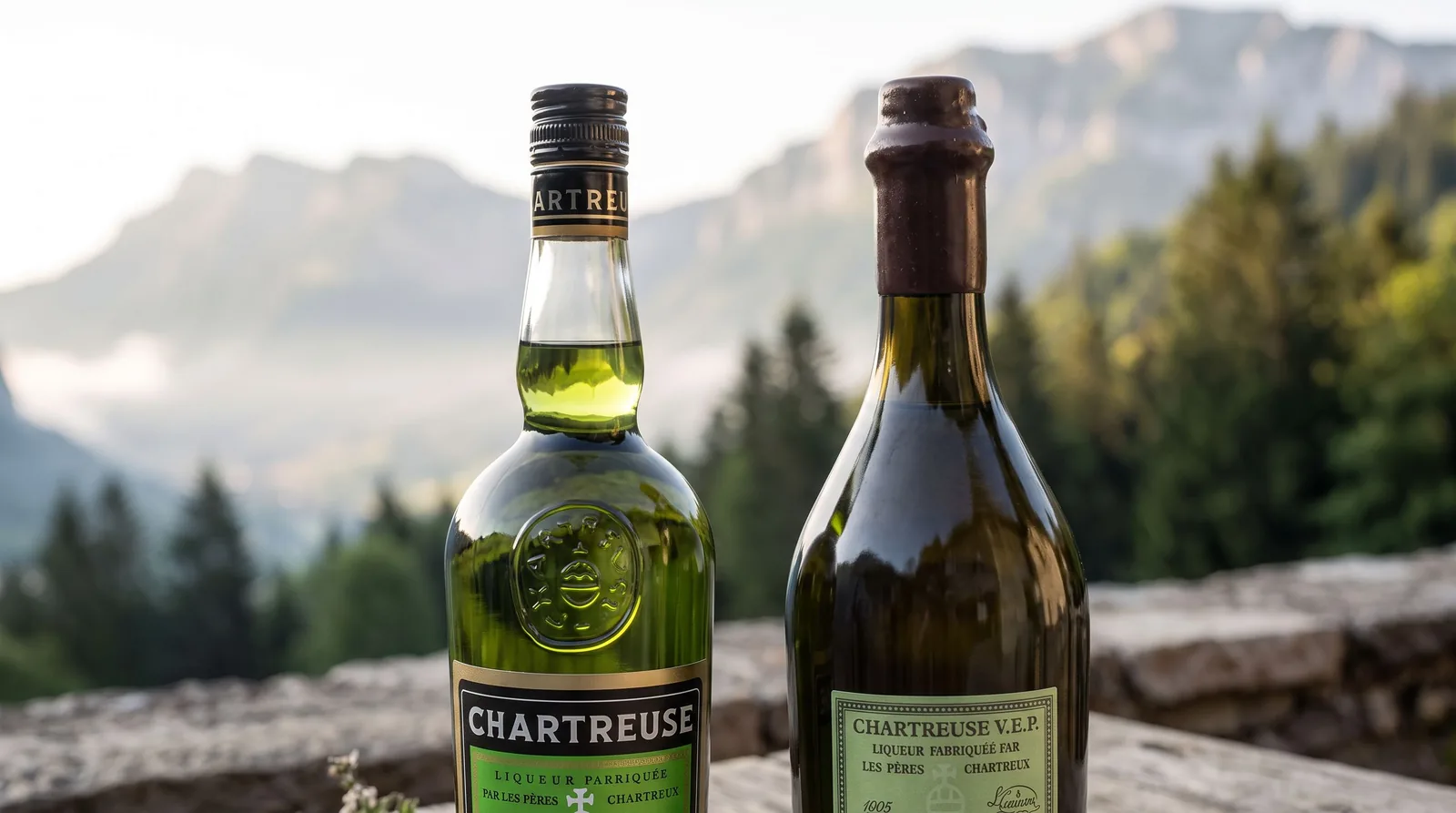
You have five clues: the label, the capsule and seal, the lot code, the strength and volume, and the glass itself.
The label
Liqueur fabriquée à Tarragone par les Pères Chartreux points to the Spanish period from 1903 to 1989. Chartreuse S.A.E. Tarragona with a black capsule is the late Tarragona period, 1982-1989. Une Tarragone is Marseille from 1921, Jadis is Fourvoirie 1932-1935, Voiron is 1936-2018 and Aiguenoire is from 2018. The L. Garnier signature has been on every label since 1869 and so says nothing about age. It is, however, a mark of authenticity: according to Difford's Guide the label contains a deliberate misprint by which fakes can be spotted.
Capsule and seal
A silver capsule indicates a bottle from before 1980, a black one a bottle from after. Wax seal and cork are found on the V.E.P., the Épiscopale and on bottles from before the 1950s. Spanish bottles carry a health-insurance stamp around the cork, and on the Santa Tecla the year is on the back label.
The lot code
Since 1991 the gold band at the neck has carried a six-digit number. The first three plus 1084 give the bottling year, the last three the day of the year, as Tales of the Cocktail explains. For bottles after 1991 this is the most reliable clue.
Strength and volume
71 degrees points to the early Élixir, 55 to Verte and 40 to an old Jaune. Very old bottles often state no volume or strength. Volumes of 50 and 75 cl are typical of older bottles; 70 cl is the current standard.
Glass and colour
The bulbous neck and the embossed seal are the fixed form. El Gruño has an embossed coat of arms. The 1605 and the special cuvées come in smoked glass that protects the chlorophyll. A faded green liqueur, palotte as French collectors say, indicates light damage, not loss of aroma. The standard work for anyone wanting to dig deeper is Chartreuse, histoire d'une liqueur, guide de l'amateur by Michel Steinmetz (Glénat, 2006), with a photograph of every bottle style by era.
Indicative auction prices
Auction prices vary widely by lot, fill level and label condition. The amounts below are hammer prices or totals including buyer's premium, as stated by the auction house, with the date. Reference date for this overview: 3 November 2026.
| Bottle | Price | Auction and date | Source |
|---|---|---|---|
| V.E.P. Verte and Jaune Couronnement 1953/1966, 2 bottles in box | CHF 34,160 | Baghera, Geneva, March 2023 | Baghera |
| Chartreuse 1840-1852, from the monastery | CHF 24,400 | Baghera, March 2023 | Baghera |
| Jaune 1878-1903, Fourvoirie | CHF 17,080 | Baghera, March 2023 | Baghera |
| Verte Une Tarragone 1921-1929 | CHF 15,860 | Baghera, March 2023 | Baghera |
| La Tarragone du Siècle, no. 127/512 | €10,912 | Cannes Auction (Besch), 27 December 2024 | Gazette Drouot |
| Chartreuse Blanche 1860-1900 | €8,000 per bottle | auction 2012 | Lyon Capitale |
| Jeroboam Jaune 1952 / Verte 1956-1964 | €7,460 / €7,219 | iDealwine, undated | iDealwine |
| Une Tarragone Jaune, bottled in Marseille 1921-1929, 1 l | €5,960 incl. premium | Fine Spirits Auction, 30 January 2026 | Fine Spirits |
| Cuvée Marseille 1921-2021, 1 of 760 | €4,768 incl. premium | Fine Spirits Auction, July 2025 | Fine Spirits |
| Jaune Tarragona 1912-1913, 50 cl | £3,900 | Whisky.Auction, September 2022 | Whisky.Auction |
| Une Chartreuse 2015, 1 of 120 | €3,457 incl. premium | Fine Spirits Auction, August 2024 | Fine Spirits |
| Verte Jadis 1932-1935, 50 cl | £2,000 | Whisky.Auction, February 2024 | Whisky.Auction |
| V.E.P. Jaune bottled 1964, 1 l, box | €1,907 incl. premium | Fine Spirits Auction, undated | Fine Spirits |
| Édition Cuivre 2021, 3 l | €1,907 incl. premium | Fine Spirits Auction, December 2025 | Fine Spirits |
| Verte El Gruño 1965-1966 | £1,200 | Whisky.Auction, June 2025 | Whisky.Auction |
| Épiscopale du IIIe Millénaire, 1 l | €1,013 incl. premium | Fine Spirits Auction, undated | Fine Spirits |
| Tarragone Verte 1982-1989 | €715 to €2,596 | Fine Spirits Auction, 2020-2024 | Fine Spirits |
| V.E.P. Verte, bottled 2024, 1 l | £250 | Whisky.Auction, December 2025 | Whisky.Auction |
| Liqueur du Foudre 147 | €131 to €166 | Fine Spirits Auction, 2025 | Fine Spirits |
| 9e Centenaire, bottled 2022 | €95 to €113 | Fine Spirits Auction, 2024-2026 | Fine Spirits |
Two auctions set the benchmark. The Baghera sale of March 2023 in Geneva, 648 lots, all sold for a combined 1.52 million Swiss francs, counts as the largest Chartreuse auction ever. In December 2024 Besch in Cannes auctioned a single-owner collection of 650 bottles, from 1903 to the present day, in 489 lots. For comparison: in the United States a V.E.P. Verte costs 300 to 7,000 dollars in the shops, according to VinePair, depending on the year. A bottle of Chartreuse is never just a drink. At auction you are buying a piece of the order's history, with all the uncertainty that brings.
Frequently asked questions
What does Tarragone mean on a bottle of Chartreuse?
That the liqueur was made in Tarragona between 1903 and 1989, after the monks were expelled from France. A bottle marked Une Tarragone was bottled in Marseille between 1921 and 1929.
Does Chartreuse Blanche still exist?
No. According to Wikipedia the white Chartreuse was made from 1860 to 1880 and again from 1886 to 1903, at 30 per cent. According to the sources consulted it was never reissued. A bottle fetched about 8,000 euros in 2012.
How much is an old bottle of Chartreuse worth?
From under 100 euros for a recent 9e Centenaire to tens of thousands of euros for bottles from the monastery or the early Tarragona period. The condition of the label, capsule and fill level weighs heavily.
How long does a V.E.P. age?
Chartreuse says many years, without a figure. Retailers speak of at least eight years; other sources of more than ten. The monks decide batch by batch.
Which bottles of Chartreuse can I still simply buy today?
The Verte, the Jaune and the Élixir Végétal, and with some luck the 9e Centenaire, the 1605 and the MOF. Since 2023 everything has been sold on allocation, so even the standard bottles are not always in stock.
Sources
- Chartreuse, official site, range and categoriesfr · 2026-11-03
- Chartreuse Verte, product page, Chartreuse.frfr · 2026-11-03
- Chartreuse Jaune, product page, Chartreuse.frfr · 2026-11-03
- Chartreuse V.E.P. Verte, Chartreuse.frfr · 2026-11-03
- Liqueur du Foudre 147, Chartreuse.frfr · 2026-11-03
- Chartreuse report, production ceiling and Aiguenoire, Lyon Capitalefr · 2025
- Il commande 4 chartreuses de plus d'un siècle, Lyon Capitalefr · 2013
- Enchères fabuleuses pour des flacons de Chartreuse, iDealwinefr · 2026-01-06
- Chartreuse, la reine des liqueurs, iDealwinefr · 2026-11-03
- La Chartreuse du siècle, La Gazette Drouot via Cannes Auctionfr · 2025-01
- Quelques Chartreuses en photo, La Passion du Vin forumfr · 2006
- Tarragone Verte 1982-1989, Fine Spirits Auctionen · 2026-11-03
- Once upon a time, Chartreuse, auction results, Bagheraen · 2023-03
- A Guide to Collecting Vintage Chartreuse, Tales of the Cocktailen · 2017
- Chartreuse (liqueur), Wikipediaen · 2026-11-03