Chartreuse is a herbal liqueur made by the Carthusian monks of the French Alps from 130 plants, flowers, barks, roots and spices. It comes in two main colours: a powerful green at 55 per cent and a gentler yellow at 43 per cent. Alongside them is the Élixir Végétal, the 69 per cent medicinal extract from which it all began. The recipe has been secret since 1605 and is guarded today by a handful of monks.
On this page you will read what sets the colours apart, how the liqueur tastes, the temperature to pour it at, which cocktails are classically made with it and why it has been so hard to find since 2023.
Green, yellow and the Élixir
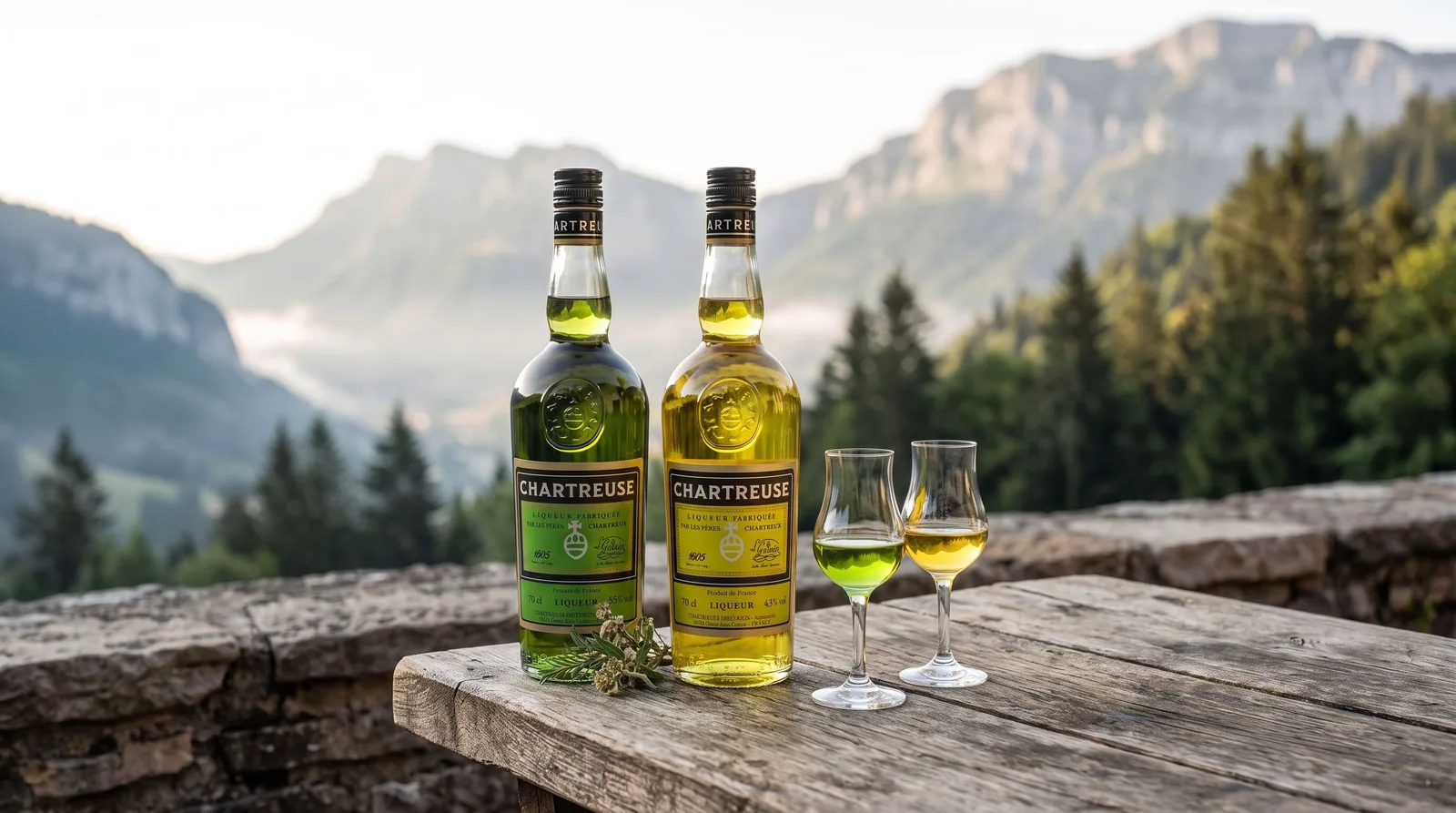
Chartreuse Verte is the best known. It is bottled at 55 per cent and owes its colour to the plants themselves, with no added colouring. Isère Attractivité calls it the only naturally green liqueur in the world. Chartreuse Tourisme adds that the monks are the only liqueur makers who know the secret of that plant-based green colour.
Chartreuse Jaune is softer and rounder. It was born in 1838, when Brother Bruno Jacquet made a white lemon-balm liqueur and Colomban Mure-Ravaux developed a pale yellow, milder blend from it. It was given its name in 1840. Chartreuse.fr today lists 43 per cent; older sources and old labels say 40 per cent. In the region it is known as la Reine des Liqueurs. According to Isère Attractivité it uses the same plants as the green, in different proportions.
The Élixir Végétal de la Grande-Chartreuse is the original product. It is a 69 per cent plant extract, sold in a 10 cl bottle inside a small wooden case that protects the contents from light. You do not drink it from a glass but from a teaspoon, on a sugar cube, in a herbal tea or in a grog with honey and lemon. The process was set down in 1764, which counts as the official founding year of the liqueur.
Beyond those three there are older and special bottles, from the V.E.P. to the Liqueur du 9e Centenaire. You will find them on the page about varieties and bottles.
How Chartreuse tastes
The green is above all herbal and fresh. Chartreuse.fr describes a complex, powerful nose with pepper and clove, a palate of mint, pine resin and citrus, and a tea-like bitterness on the finish. At 55 per cent it feels smooth and warm. Difford's Guide picks out, among other things, angelica, pine, lime, peppermint, aniseed, cocoa, ginger and black pepper.
The yellow is a deep golden yellow, soft and round. On the palate come turmeric, citrus, a light touch of aniseed and floral notes that linger for a long time. A bartender in Washington summed up the difference like this: the yellow has something creamy and vanilla-like, while the green picks up far more spice.
Exactly which plants you are tasting remains guesswork. Only the number 130 is official; not a single plant has ever been confirmed. The lists in circulation, and how much of them holds up, are discussed on the page about the ingredients.
A tasting tip from the house itself: look at the colour first, then nose it, and with the green hold the glass a little further from your nose to avoid the alcohol vapours. A first small sip prepares your palate; only the second tells the whole story.
How to serve Chartreuse
The recommended temperature is cool, between 11 and 13 degrees, in a liqueur glass or on the rocks. Put the bottle in the fridge for a few hours or chill the glasses. For the V.E.P. the house advises 13 to 15 degrees, slightly warmer, so the aromas from the ageing can open up.
Do not put the bottle in the freezer. That deadens the aromas and can cause the plant particles in the liqueur to crystallise. If you want your Chartreuse ice cold, chill the glasses rather than the drink.
Traditionally Chartreuse is a digestif. Since the nineteenth century it has also turned up in cocktails and in the kitchen, sweet and savoury. A classic blend from the house is the Épiscopale, one part green to two parts yellow, which was given a name of its own in 1990. In Saint-Laurent-du-Pont, chocolatière Sandrine Chappaz makes chocolate with green Chartreuse.
Drink responsibly. A 55 per cent liqueur is drunk in small quantities and slowly; that is also the only way to taste the layers.
The classic cocktails
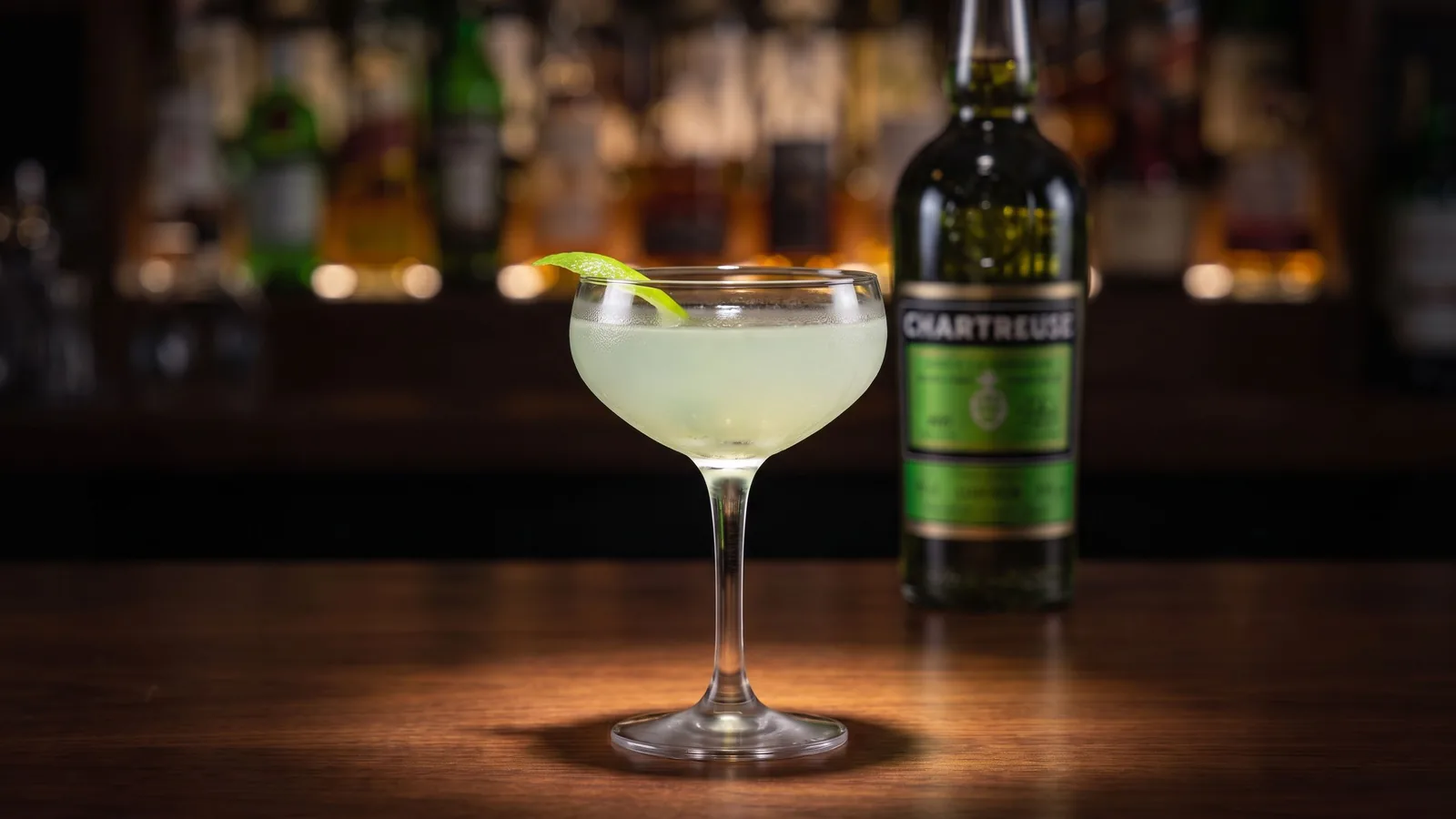
The house's official cocktail list includes the Last Word, Bijou, Chartreuse Swizzle, Green Chaud and Chartreuse Tonic, among others. Below are the classics bartenders know the world over, with the proportions from the standard reference works.
| Cocktail | What goes in | Origin |
|---|---|---|
| Last Word | Gin, Chartreuse Verte, maraschino and lime juice in almost equal parts (Difford's: one part gin to two thirds of each of the others), shaken. | Detroit Athletic Club, 1916 menu. Rediscovered in 2003 by Murray Stenson of the Zig Zag Café in Seattle, who later said: "We sold the heck out of it." |
| Bijou | Equal parts Chartreuse Verte, Italian vermouth and Plymouth gin, with orange bitters. | Harry Johnson, Bartender's Manual (1900). The name refers to three jewels: diamond, ruby and emerald. Chartreuse.fr itself dates the cocktail to around 1860; the sources disagree. |
| Alaska | Three parts dry gin to one part Chartreuse Jaune, shaken. | Harry Craddock, Savoy Cocktail Book (1930), with an older variant from 1914. |
| Champs-Élysées | Three parts cognac, one part Chartreuse, one and a half parts sweetened lemon juice, a dash of Angostura. | Drinks Long and Short (1925); a variation on the Sidecar. |
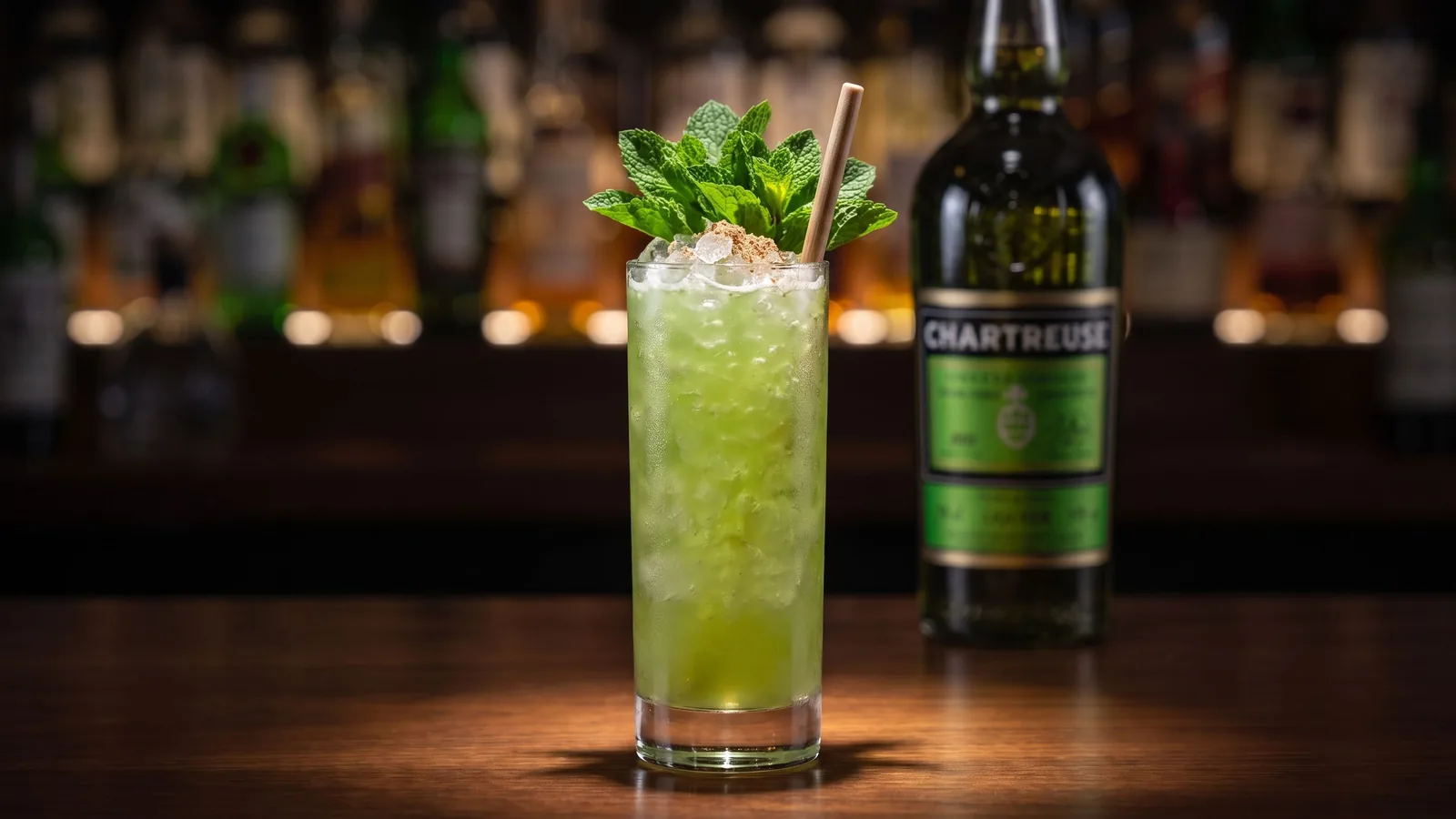
| Chartreuse Swizzle | 45 ml Verte, 15 ml falernum, 45 ml pineapple juice, 22 ml lime, over crushed ice, with nutmeg. | Marco Dionysos, Tres Agaves, San Francisco, 2002. |
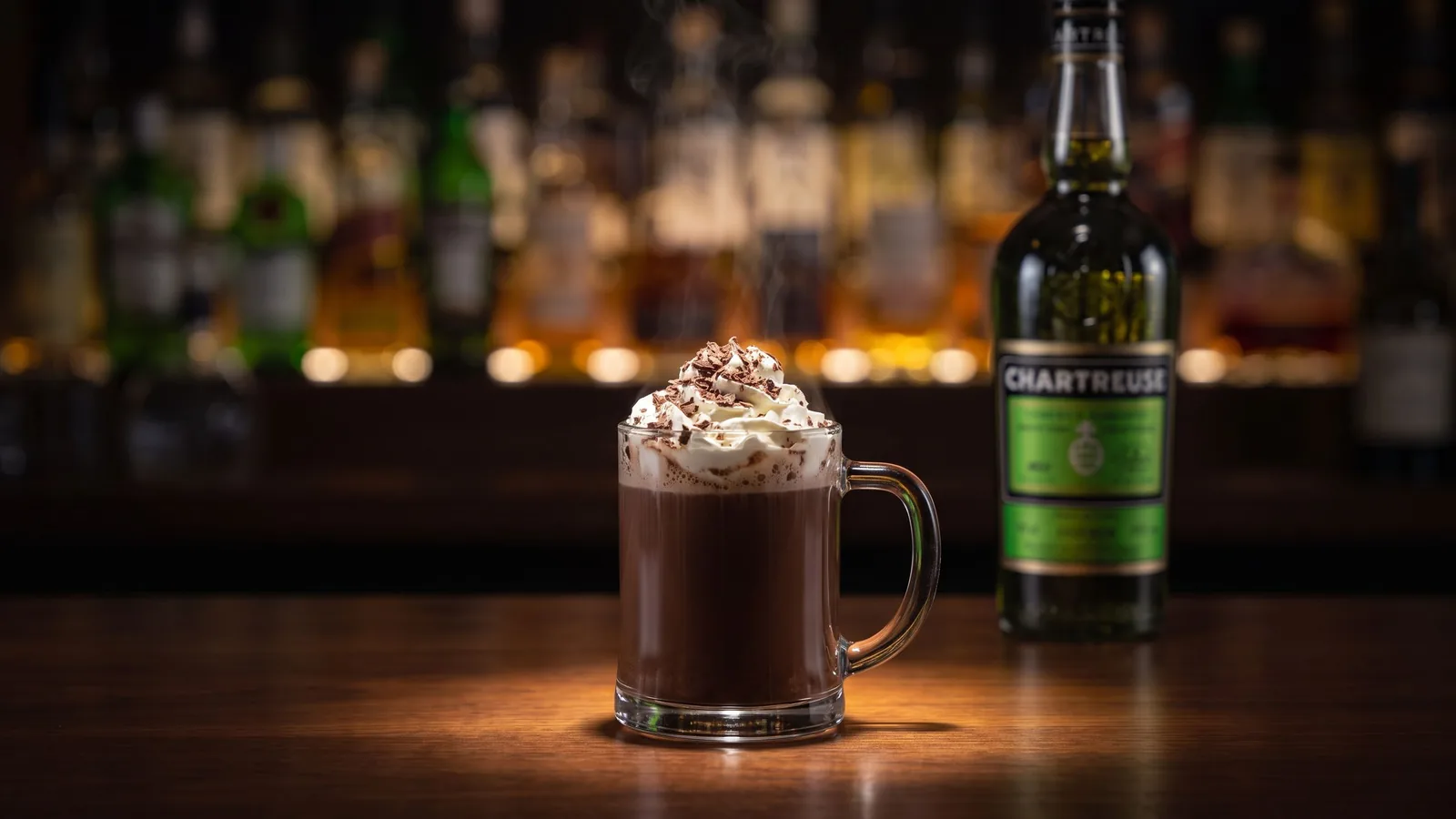
| Green Chaud | Hot chocolate with Chartreuse Verte, usually three parts hot chocolate to one part liqueur. | A ski-resort drink; at Le Collet, in the Chartreuse massif, you get one after the torchlight descent. |
| Chartreuse Tonic | Chartreuse with tonic, the simplest on the list. | Appears on the house's official cocktail page. |
A charming legend surrounds the Green Chaud as a centuries-old Alpine tradition. Punch found no evidence for it: the French sales team promoted the combination in the 1980s as "Chartreuse Chocolat" on the back label, and the earliest printed mention is a Welsh newspaper from 1984. It is delicious all the same.
During the shortage some bartenders replaced the Chartreuse in the Last Word with Aperol and called the result the "First Word". If you are looking for a bar in Belgium that still pours real Chartreuse, you will find addresses on our page about Chartreuse in Belgium.
Why Chartreuse changes in the bottle
Chartreuse keeps evolving after bottling. Chartreuse.fr states in so many words that the liqueur goes on developing its complexity in the bottle. The explanation lies in the finishing: after ageing in oak foudres the liqueur receives only a coarse filtration, so the plant components stay "alive" and continue to evolve. VinePair sums it up as a drink that behaves more like wine than like a liqueur. Whether older bottles are therefore also better is a matter of taste; Wikipedia flags that claim as disputed.
That is why connoisseurs look at the bottling year. You can read it from the lot number near the neck: an L followed by six digits. The first three digits plus 1084, the year the order was founded, give the year; the last three give the day of the year. L940004 is therefore 4 January 2024.
A Paris sommelier put it this way to Club Oenologique: he has to sell his bottles now, but at four or five years old is when they become truly impressive. How the ageing in the foudres actually works is covered on the page about the production process.
Why it is so scarce
Since 2023 there have been empty shelves and waiting lists. The reason is not a production fault but a choice. Demand doubled during the pandemic of 2020, and the monks decided not to follow it. In a letter to their partners in January 2023, Chartreuse Diffusion wrote that making millions of cases makes no sense in the current environmental context, and that the house wants to do "less but better and for longer". Since then sales have been on allocation.
On the exact ceiling the sources disagree. Lyon Capitale writes that Prior Dom Dysmas capped production in 2021 at 1.2 million litres a year, roughly two million bottles. The New York Times, as quoted by Wikipedia, puts it at a decision in 2019 and 1.6 million bottles. The prior himself put it briefly to the directors in early 2023: "La croissance infinie n'est plus possible." Infinite growth is no longer possible.
There is a practical reason too. Managing director Emmanuel Delafon explained in Le Dauphiné Libéré that heatwaves and drought are making the 130 plants harder to find; producing twice as many plants simply would not work. Nor does the order want to grow beyond what it needs to maintain its monasteries.
One last figure that puts the scarcity in perspective: about half of all Chartreuse is sold in France, and 70 per cent of that in the Rhône-Alpes region. According to Chartreuse Diffusion, more Chartreuse is sold in the Isère than in the United States. If you want to taste the liqueur where it is at home, read on at the page about the region; if you want to know how they arrived at that choice, go to the page about the history.
Frequently asked questions
What is the difference between green and yellow Chartreuse?
The green is 55 per cent alcohol and is herbal, peppery and fresh, with mint, pine resin and a bitter finish. The yellow is 43 per cent and is softer and rounder, with turmeric, citrus and floral notes. According to Isère Attractivité both use the same plants, in different proportions.
At what temperature should you serve Chartreuse?
Cool, between 11 and 13 degrees, in a liqueur glass or on the rocks. The V.E.P. is drunk slightly warmer, at 13 to 15 degrees. Do not put the bottle in the freezer: that deadens the aromas and can make the plant particles crystallise.
How do I know what year my bottle is from?
Look at the lot number near the neck: an L with six digits. Add 1084 to the first three digits and you have the bottling year; the last three digits are the day of that year.
Why is Chartreuse so hard to find?
The monks have deliberately capped production and have sold on allocation since 2023. They do not want to grow beyond what the order needs, and climate change is making the 130 plants harder to find.
What is the Élixir Végétal?
The original 69 per cent plant extract, whose process was set down in 1764. You take it by the teaspoon, on a sugar cube, in herbal tea or in a grog. The 10 cl bottle comes in a small wooden case to protect it from light.
Sources
- Dégustation, digestif (tasting notes and serving temperature), Chartreuse.frfr · 2026-11-03
- Dégustation, cocktails (official cocktail list), Chartreuse.frfr · 2026-11-03
- Histoire de la chartreuse, Chartreuse.frfr · 2026-11-03
- Chartreuse Jaune, product page, Chartreuse.frfr · 2026-11-03
- Élixir Végétal, product page, Chartreuse.frfr · 2026-11-03
- Chartreuse V.E.P. Verte, Chartreuse.frfr · 2026-11-03
- La Chartreuse, la liqueur, Alpes Isère (Isère Attractivité)fr · 2026-11-03
- Escapades en Isère, Chartreuse, l'or vert des Alpes, Lyon Capitalefr · 2025-11-27
- La stratégie décapante des chartreux pour leur breuvage, Aleteia (quoting Le Dauphiné Libéré)fr · 2023-03-25
- The Chartreuse, a liqueur, Chartreuse Tourismeen · 2026-11-03
- Chartreuse liqueurs, behind the scenes, Taste Franceen · 2026-11-03
- How to read the Chartreuse production-date code, VinePairen · 2024-01-01
- The Chartreuse shortage, explained, VinePairen · 2023-03-27
- Green Chartreuse, the monks' decision, The Daily Pouren · 2023-03-02
- Verte Chaud, Punchen · 2026-11-03